Shop · Robotics & UAS Hardware
Jetson / FC-Stack Vibration Mount
A printed soft-mount with a computed, tunable isolation curve.
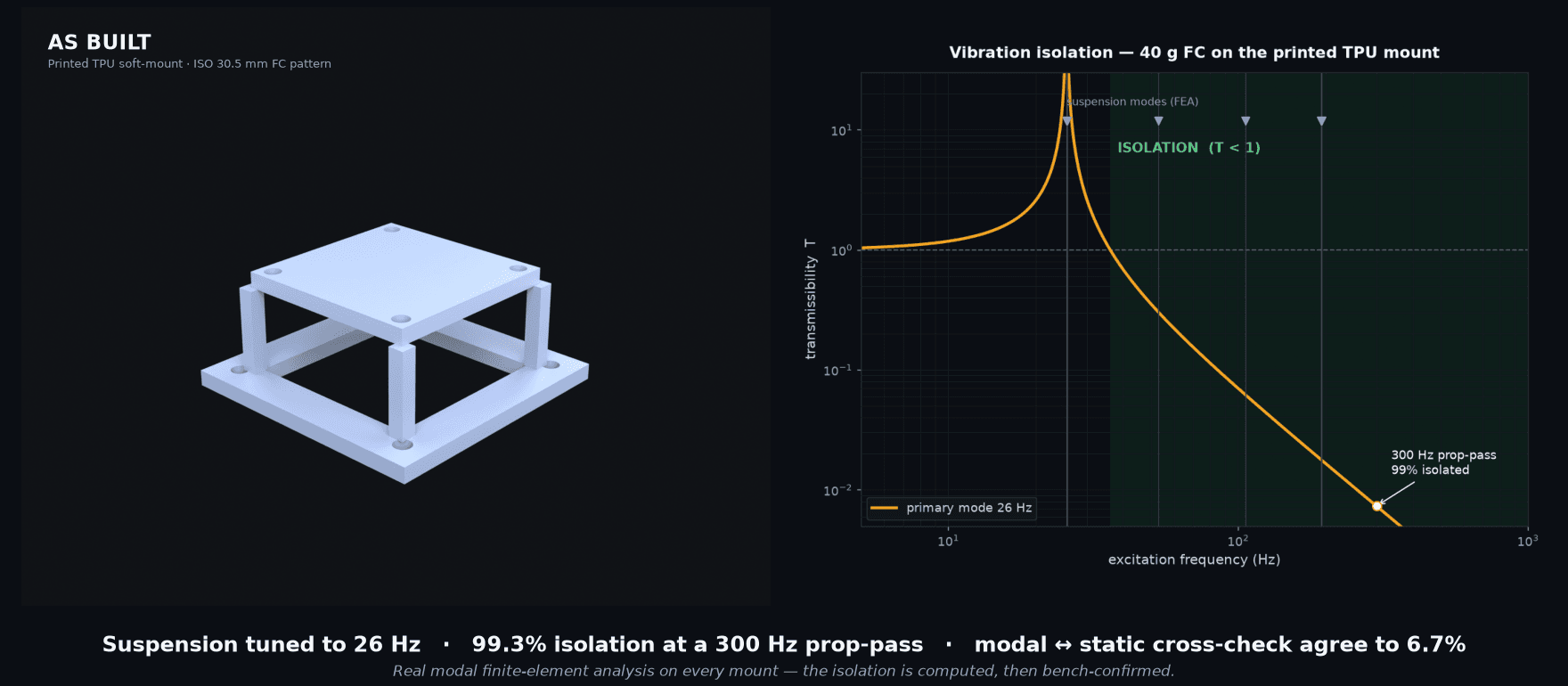
Each configured mount is tuned to your payload and re-solved, not interpolated: across the offered 80–400 g range every point holds the governing rocking mode at least 1.8× below the 150 Hz floor (56–76% isolation at the floor, worst case published), the modal FEA is cross-checked by an independent static stiffness solve, and every point passes a 1 g gravity buckling stability check. The rating curve is committed evidence (CONFIG_SWEEP), and the as-built is confirmed with a bench accelerometer sweep.
How we engineered this: a computed, tunable isolation curve →
Specifications
| Governing mode | Tuned per payload: every offered point holds the governing rocking mode ≥1.8× below the 150 Hz floor (modal FEA, independent static cross-check ≤6%) |
|---|---|
| Isolation @ 150 Hz floor | 56–76% on the governing rocking axis across the offered range (per-point FEA); softer axes near-fully isolated — all axes published, no cherry-pick |
| Payload | 80–400 g (Jetson / companion computer / full FC stacks), tuned and re-validated per order; sub-80 g boards not offered pending a v0.2 leg rework |
| Stability | Every offered point passes a 1 g gravity buckling check (FEA *BUCKLE, λ ≥ 3.2) — the gate that refuses sub-80 g configs |
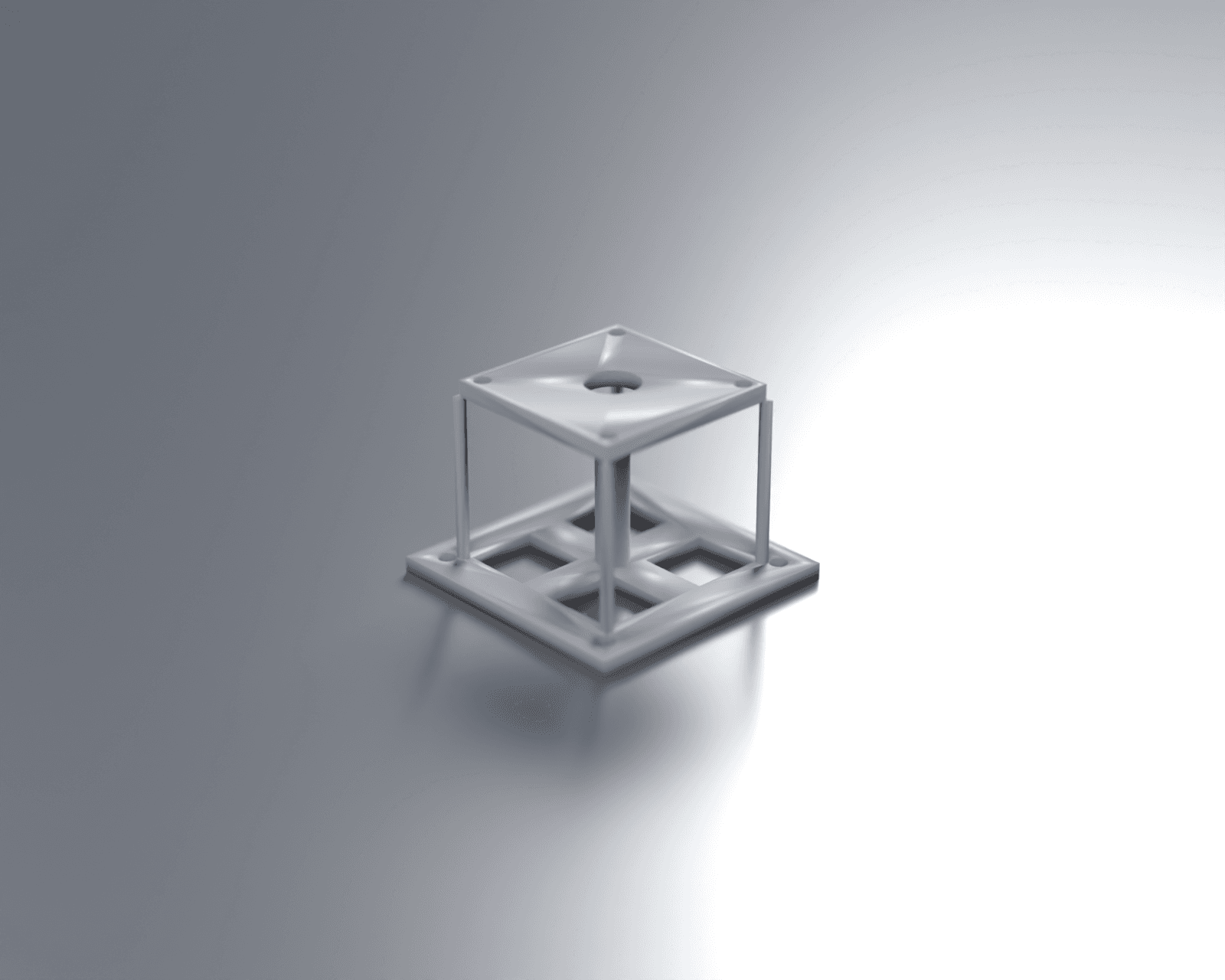
| Mount | ISO/standard 30.5 mm FC pattern; base bolts to the drone; central snub limits over-travel |
| Material | TPU 80A/95A (the isolator) — durometer is a tuning knob |
| Analysis | CalculiX modal *FREQUENCY + static cross-check + gravity *BUCKLE stability gate |
Application and configuration notes
Achieved isolation depends on your aircraft's excitation spectrum and the TPU durometer; the stiffest (rocking) mode is the binding constraint and the tuning target, and a central snub bounds over-travel on a hard landing. Bare sub-80 g flight controllers are refused for now — at the 150 Hz floor that suspension fails our 1 g buckling gate, and the v0.2 leg-geometry rework has to earn the listing first. We tune leg stiffness to your motor band and confirm with an accelerometer sweep — that measured report is the deliverable.
The part
A vibration isolation mount for a companion computer (Jetson) or a full FC stack in the 80–400 g range: it suspends the board on four compliant TPU legs so the IMU/gyro sees clean data instead of motor and prop vibration. The base bolts to the drone frame; the platform carries the board at the standard 30.5 mm pattern. Printed in one piece — the legs are the springs, so there are no separate grommets to lose or wear. (Bare sub-80 g flight controllers are not currently offered: at the 150 Hz tuning floor, a suspension that soft fails our 1 g buckling stability check — a leg-geometry rework for light boards is in progress, and we'd rather refuse the order than ship it.)
A vibration mount is only worth anything if its suspension sits below the excitation, so we don't assert isolation — we compute it. A modal finite-element analysis maps the suspension's natural frequencies, and we cross-check it against an independent static stiffness solve: the two agree to ~5%, which is how we know the eigenanalysis is trustworthy. From that we publish the transmissibility at the excitation floor for every axis — including the governing (stiffest) one, not just the soft axis that flatters the number.
Here's the honest part, and it's the whole point: real-world isolation depends on your aircraft's vibration spectrum and the TPU durometer. So this is a tuned part. We set the leg stiffness to your motor band, re-run the analysis, and confirm the result with a bench accelerometer sweep. You're buying the engineering and the measured report, not a one-size plastic plate.