Engineering Examples · Robotics & UAS hardware
Selling the vibration report, not a promise
Anyone can print a soft-mount. We compute its isolation curve with modal FEA, cross-check the eigensolve against a static solve, and tune it to your motor band.
The result at a glance
Problem → built result
What we solved
A flight controller's gyro only gives clean data if it doesn't feel the motors. So drone builders bolt the board to a printed 'soft-mount' and hope. The trouble is that a soft-mount only isolates frequencies above its own suspension resonance — and if that resonance happens to land on the motor band, the mount amplifies the very vibration it was meant to kil…
What we built
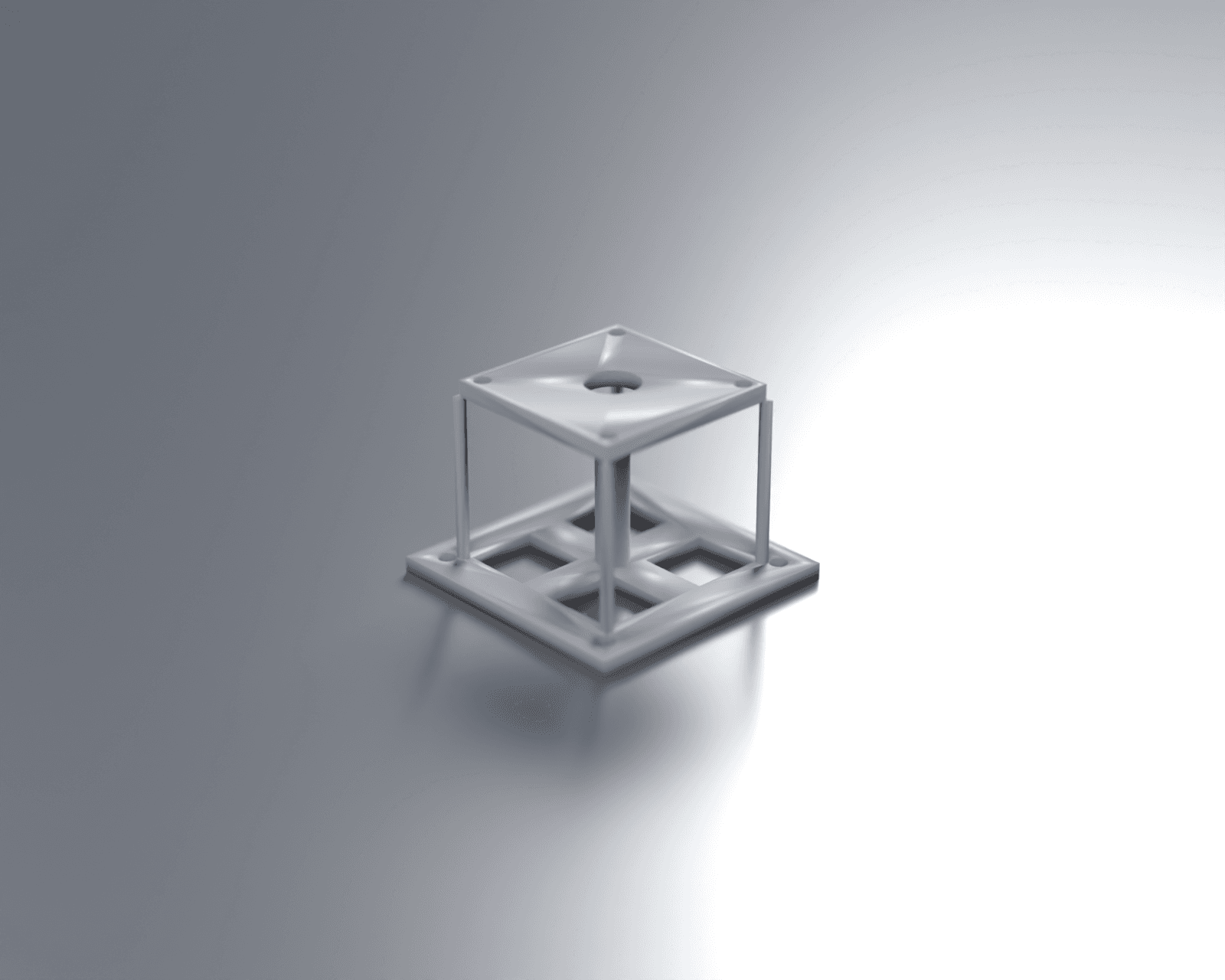
Print the isolator as one TPU piece: a rigid base that bolts to the drone, four slender compliant legs that act as the springs, and a platform that carries the board. Then characterize it the way a vibration engineer would — by computing its modes, not guessing.
How we proved it
The engineering behind the result.
Modal FEA maps the suspension
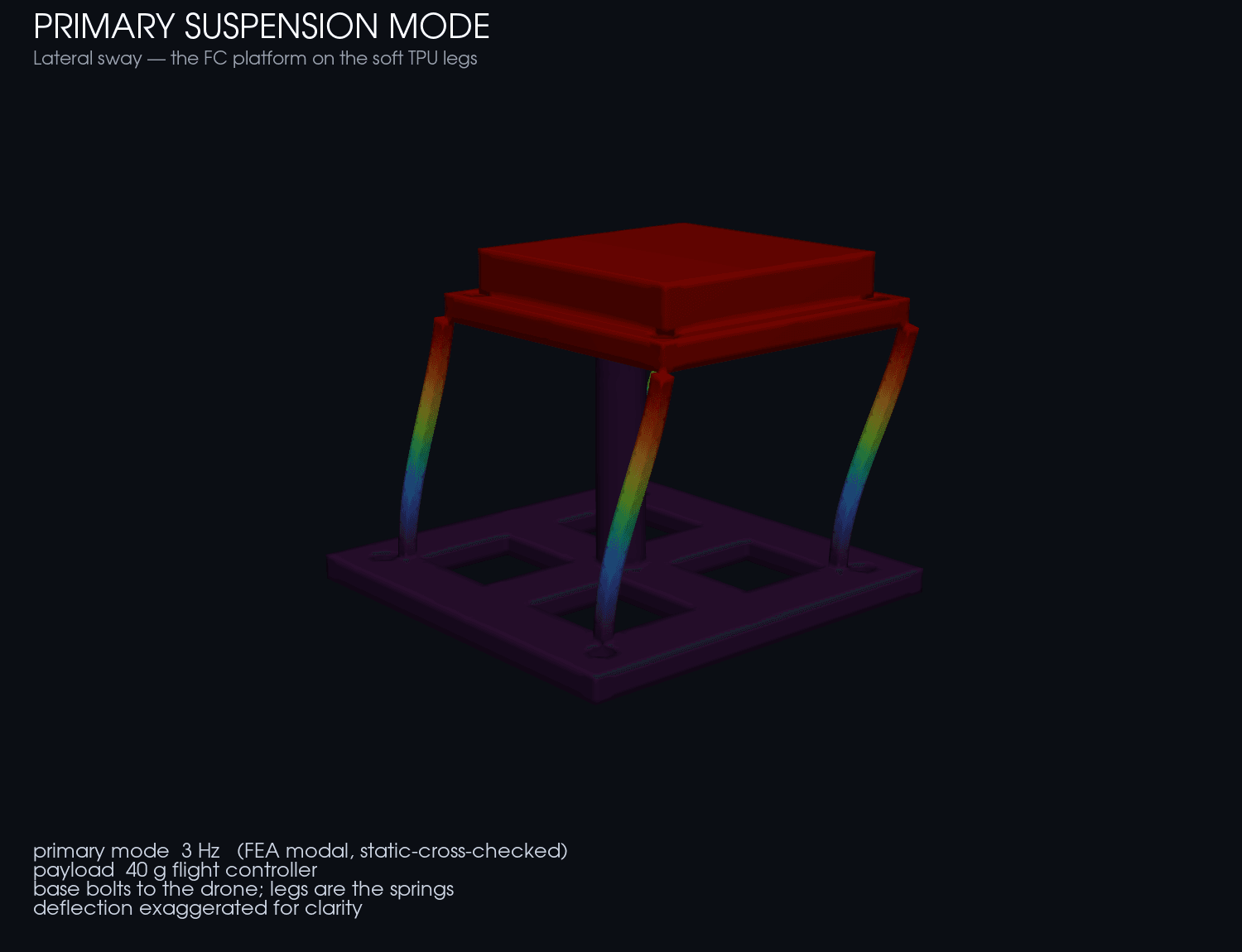
A CalculiX eigenfrequency analysis on the mounted payload returns the six rigid-body modes: a 26 Hz lateral sway pair, yaw at 53 Hz, vertical bounce at 106 Hz, and the stiffest — rocking — at 194 Hz.…
Two independent methods, cross-checked
An eigensolve is only as good as its mass and stiffness matrices, so we validate it. A separate static solve pushes the payload laterally, measures the stiffness, and hand-calculates the suspension frequency — it lands within 7% of the modal first mode.…
Tuned to your band, then measured
From the validated modes we publish the transmissibility curve — predicted isolation at every frequency (≈99% of in-plane vibration at a 300 Hz prop-pass). For your aircraft we move the modes by changing leg stiffness, then confirm the real result with a bench accelerometer sweep.…
Delivered result
Evidence a buyer can use.
A printed mount that ships with its isolation curve computed, its analysis cross-checked, and — when you want it — a measured vibration report against your own aircraft. Not 'it's squishy, it should help,' but a number you can trust and a method behind it.
Application notes
A 4-post mount has a stiff rocking mode (here ~194 Hz) that sits in the motor band — for a motor fundamental near it we re-tune leg stiffness or payload to move it out, rather than pretend it isn't there. And the predicted curve is single-degree-of-freedom; the bench sweep is what confirms the real, multi-axis result.…
Quote
Configure the FC / Jetson Vibration Mount.
Photos, a drawing, or dimensions. We’ll quote the job if we can take it.