Shop · Robotics & UAS Hardware
Vacuum Gripper Plate (EOAT)
Robot end-of-arm vacuum gripper with the manifold printed in.
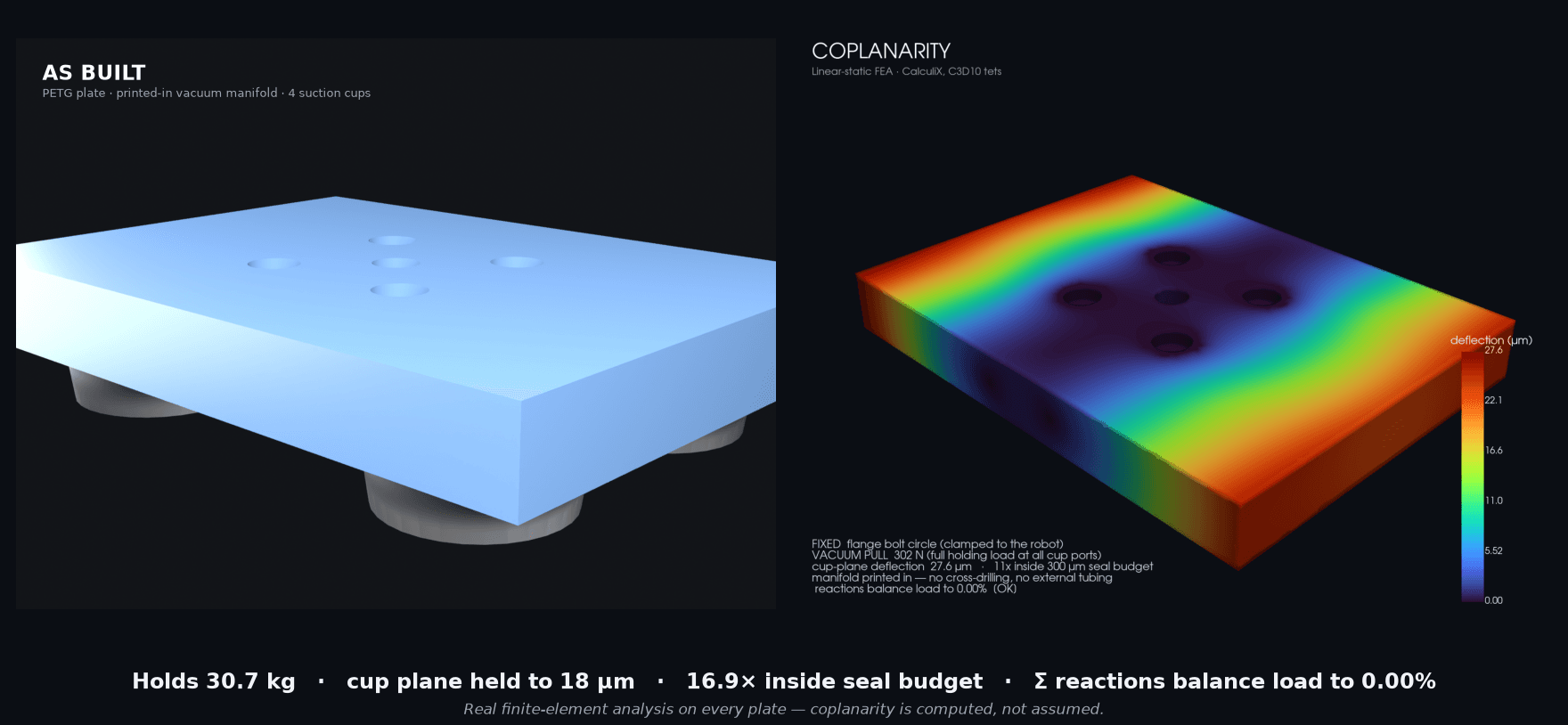
Σ reactions balance the holding load to 0.00%, and the cup plane deflects 14 µm under the full 302 N pull — 20.8× inside a suction-cup's compliance budget, so the cups stay coplanar. The structural side is computed; the holds-vacuum claim is earned by a leak-down test, not asserted.
How we engineered this: printing the manifold into the gripper →
Specifications
| Holding force | 302 N (30.7 kg) at 60 kPa across 4 cups — if vacuum is held |
|---|---|
| Rated payload | 7.7 kg (SF 2, 2g robot accel) |
| Coplanarity | 14 µm cup-plane deflection under full load (20.8× seal margin) |
| Mount | ISO 9409-1-50 flange · central vacuum inlet |
| Manifold | Printed-in runners + O-ring face seats + G1/8 / Ø6 push-to-connect fittings |
| Vacuum integrity | Validated by a leak-down test before shipping — not asserted from geometry |
| Material | PETG (sealable vacuum channels) |
| Analysis | CalculiX C3D10 FEA, equilibrium-verified |
Application and configuration notes
Structural coplanarity is independently proven; air-tightness is a scoped item — the manifold is built with sealed channel walls (epoxy-impregnation) plus O-ring face seats and G1/8 / Ø6 push-to-connect fittings, and validated by a leak-down test before it ships as a holds-vacuum EOAT. For high-cycle production or oily/porous parts we'll spec the cup compound and quote the sealed-insert build.
The part
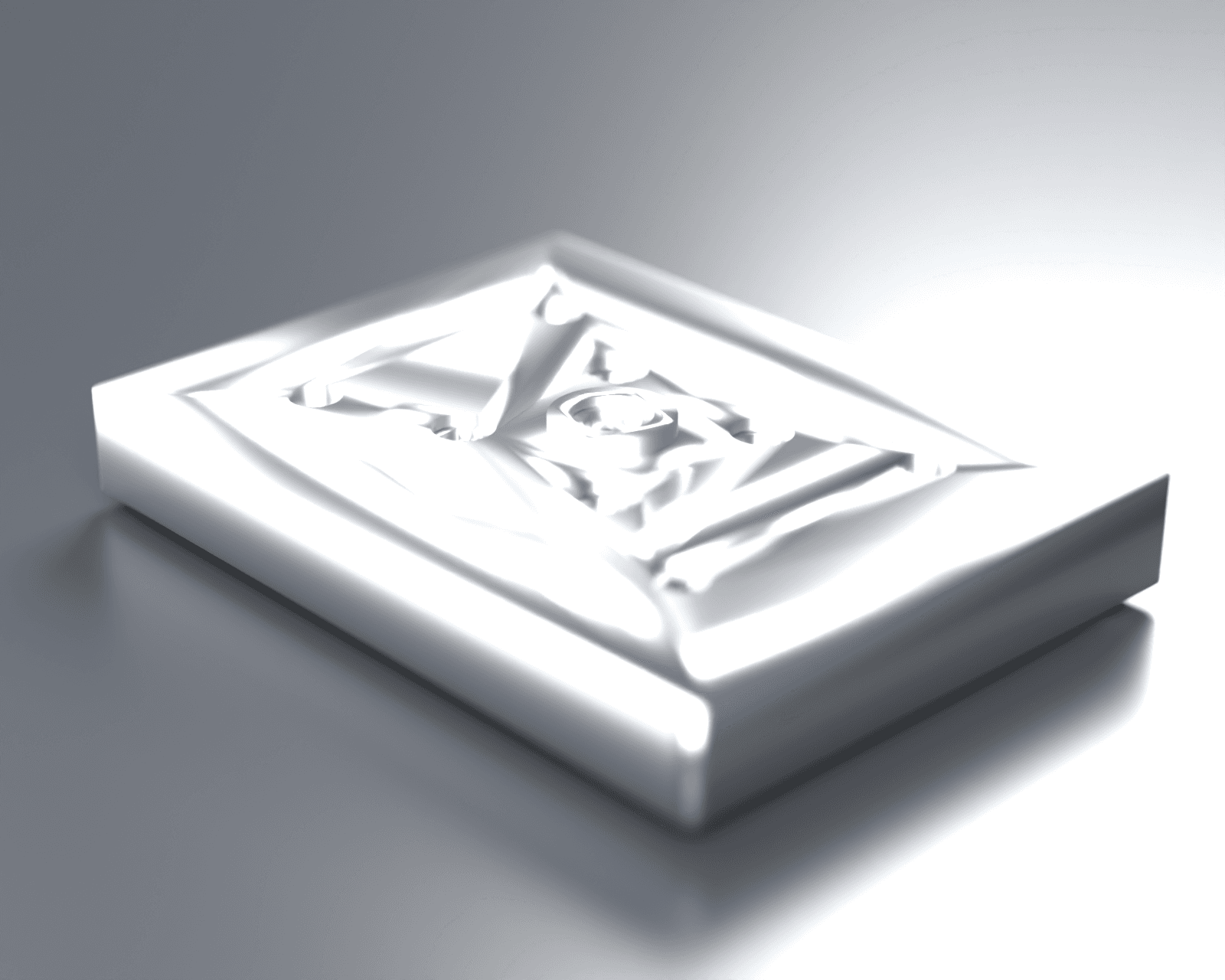
A robot end-of-arm tool (EOAT): a vacuum gripper plate that mounts to an ISO 9409-1-50 robot flange and picks parts on four suction cups. The additive edge is structural — the vacuum manifold is printed into the plate. Runners feed from the central inlet (through the flange) to each cup port, so there's no cross-drilling and no external tubing to snag or leak at a fitting.
A gripper only holds while its cups stay coplanar — if the plate flexes under load, a cup lifts and the seal breaks. So we don't assume the plate is stiff enough, we compute it: every plate ships with the FEA showing the cup plane stays flat under the full holding load, well inside a suction-cup's compliance budget.
Parametric on the cup layout — cup count and spacing configure to your part's footprint, and each configuration is re-analyzed before it ships. The honest constraint is air-tightness: a printed manifold has to be built with sealed channel walls and push-to-connect port inserts, and we build it that way on purpose.