Engineering Examples · Robotics & UAS hardware
Printing the manifold into a robot vacuum gripper
We replaced a cross-drilled, externally-plumbed end-of-arm tool with a single printed part — and proved the cups stay sealed under load.
The result at a glance
Problem → built result
What we solved
A robot end-of-arm vacuum gripper is normally a machined plate with cross-drilled air passages, a plug at every blind drill, and external tubing running out to each suction cup. The tubing snags and adds cycle-time risk; every drilled passage and every push-fit fitting is a place to leak.
What we built
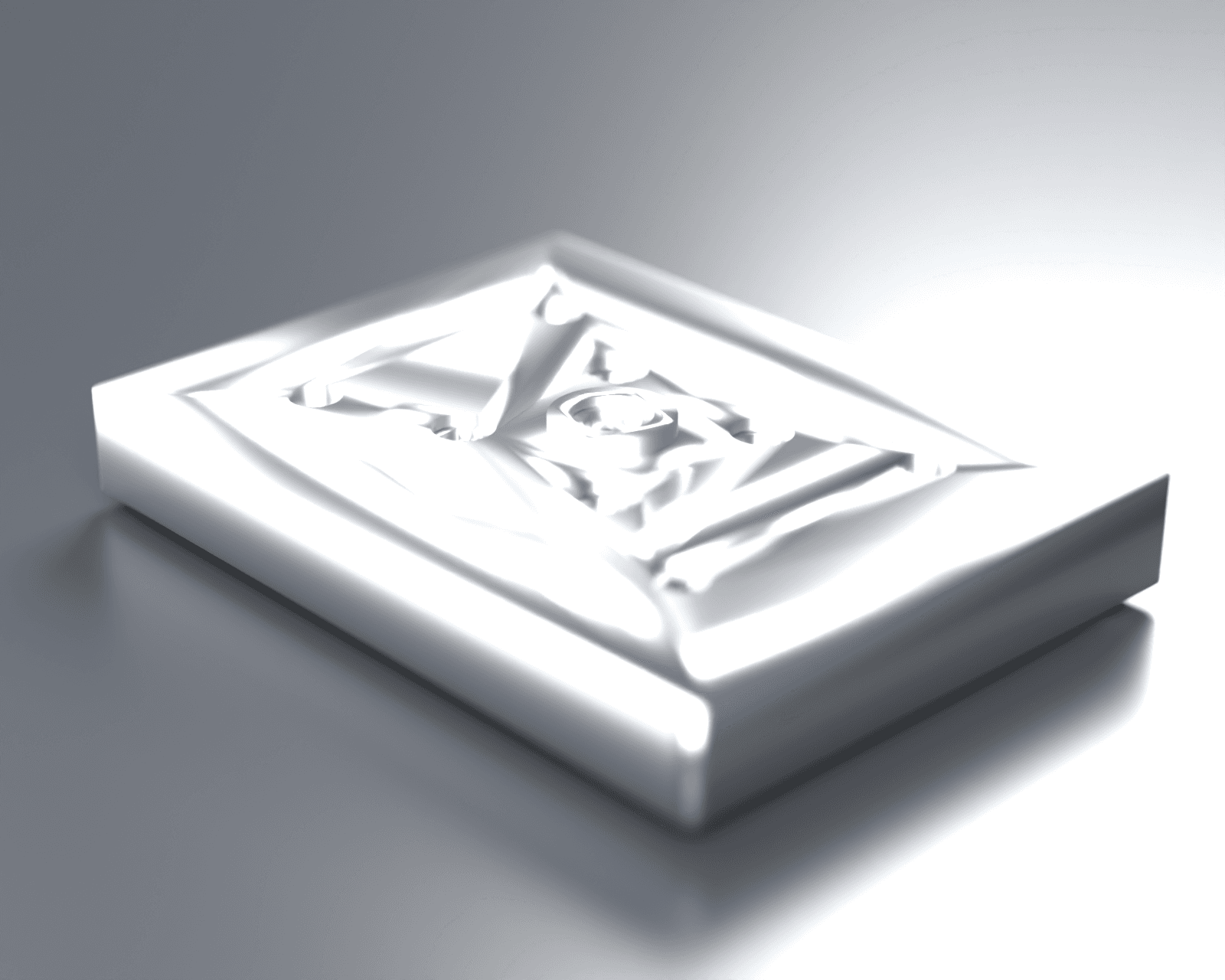
Design the plate parametrically so the cup layout is just an input, and print the vacuum manifold into the plate — internal runners from the flange-fed central inlet to each cup port. No cross-drilling, no blind-hole plugs, no external tubing. One part.
How we proved it
The engineering behind the result.
Material matched to the duty
PETG — sealable and tough, the right call for a printed vacuum manifold where PLA would be brittle and ABS would warp the channel geometry.
Holding force, from first principles
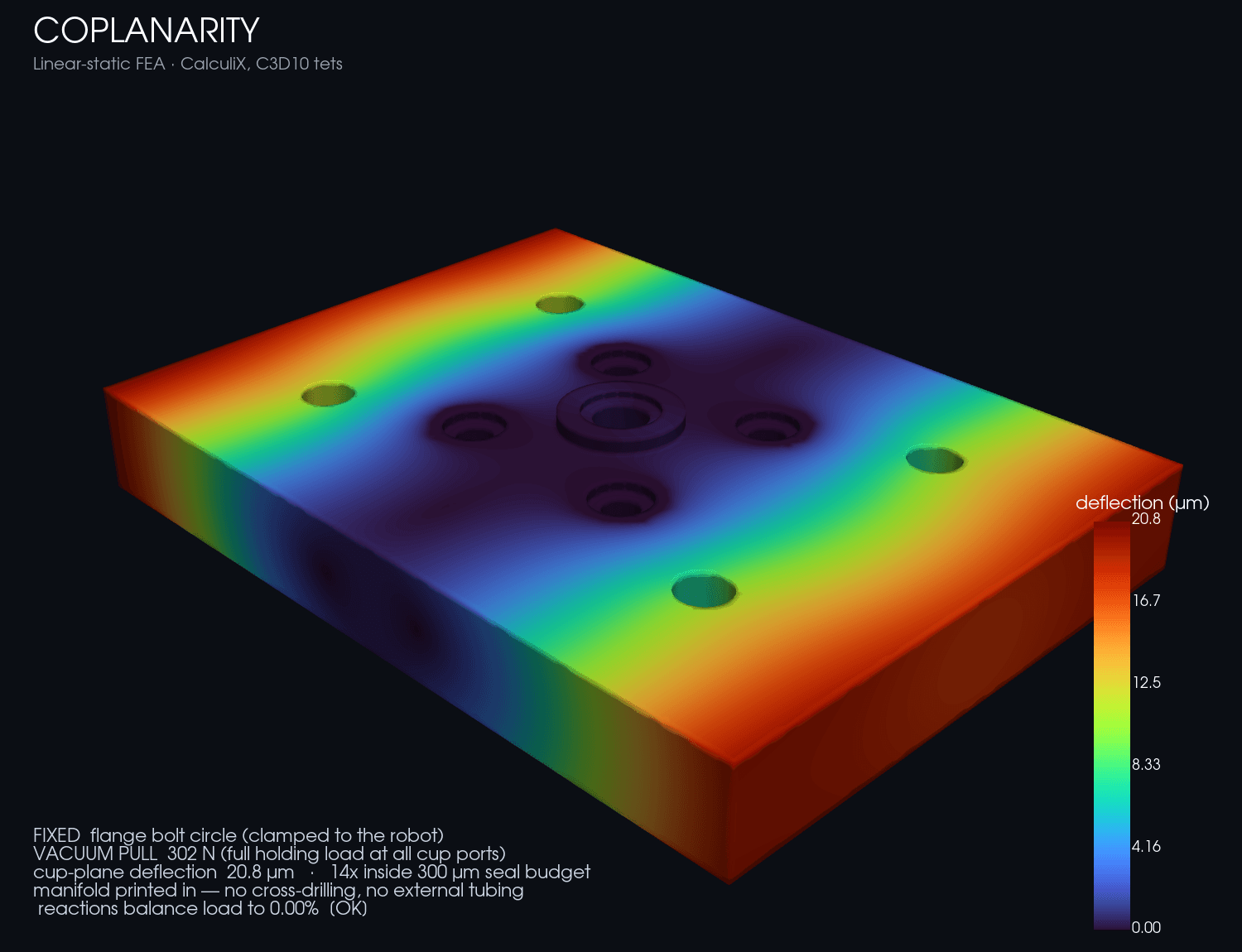
Vacuum × total cup area (Pascal's law) gives 302 N — 30.7 kg — at 60 kPa across four cups, de-rated to a 7.7 kg working payload with a 2× safety factor and a 2g allowance for robot acceleration.
Coplanarity — the claim that actually matters
A vacuum gripper only holds while its cups stay coplanar; if the plate flexes under load, a cup lifts and the seal breaks. We didn't assume the plate was stiff enough — we computed it.…
Delivered result
Evidence a buyer can use.
One printed part replaces a machined-and-plumbed assembly. The cup layout is a configurable parameter, so a part-specific gripper ships as a product instead of a weeks-long bespoke build — and it arrives with the FEA that proves it holds.
Application notes
A printed manifold lives or dies on air-tightness: the channel walls must be built solid (≥4 perimeters) and the ports fitted with push-to-connect inserts. We state that gate up front and build to it. The stiffness model uses the solid plate, since the Ø6 channels are non-structural — also disclosed.
Quote
Configure the Vacuum Gripper Plate (EOAT).
Photos, a drawing, or dimensions. We’ll quote the job if we can take it.