Shop · Production Tooling, Jigs & Fixtures
Pick-and-Place Nest / Tray
The robot keeps hitting its taught grid — and we prove it.
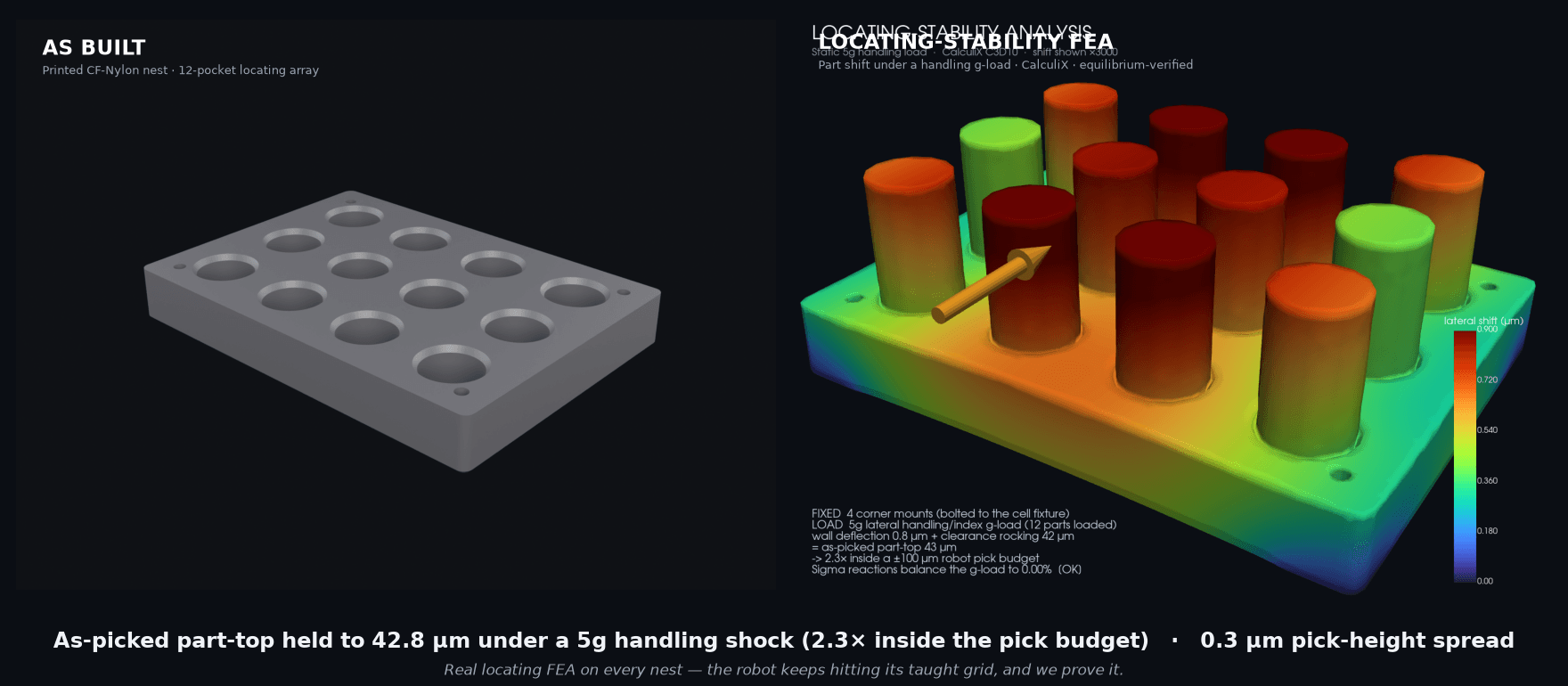
Loaded and shoved at 5g, the worst pocket holds its part's as-picked top to 42.8 µm — 2.3× inside a ±100 µm pick budget — counting the clearance rocking the fit allows, not just the wall deflection, so the robot keeps hitting its taught grid honestly. The lateral and gravity load cases independently agree on the model mass to 0.00%, and the gravity sag sits between two independent plate-bending hand-calcs. The locating is computed, then pick-mapped on the as-built.
How we engineered this: parts that stay located when the cell shoves them →
Specifications
| As-picked part shift under 5g | 42.8 µm (wall 0.8 + clearance rocking 42.0) — 2.3× inside a ±100 µm pick budget |
|---|---|
| Pick-height stability | 0.3 µm part-top Z spread under the loaded-tray weight |
| Locating | Ø25 round-bar pockets, 0.53 engagement + 2.5 mm × 35° lead-in funnels |
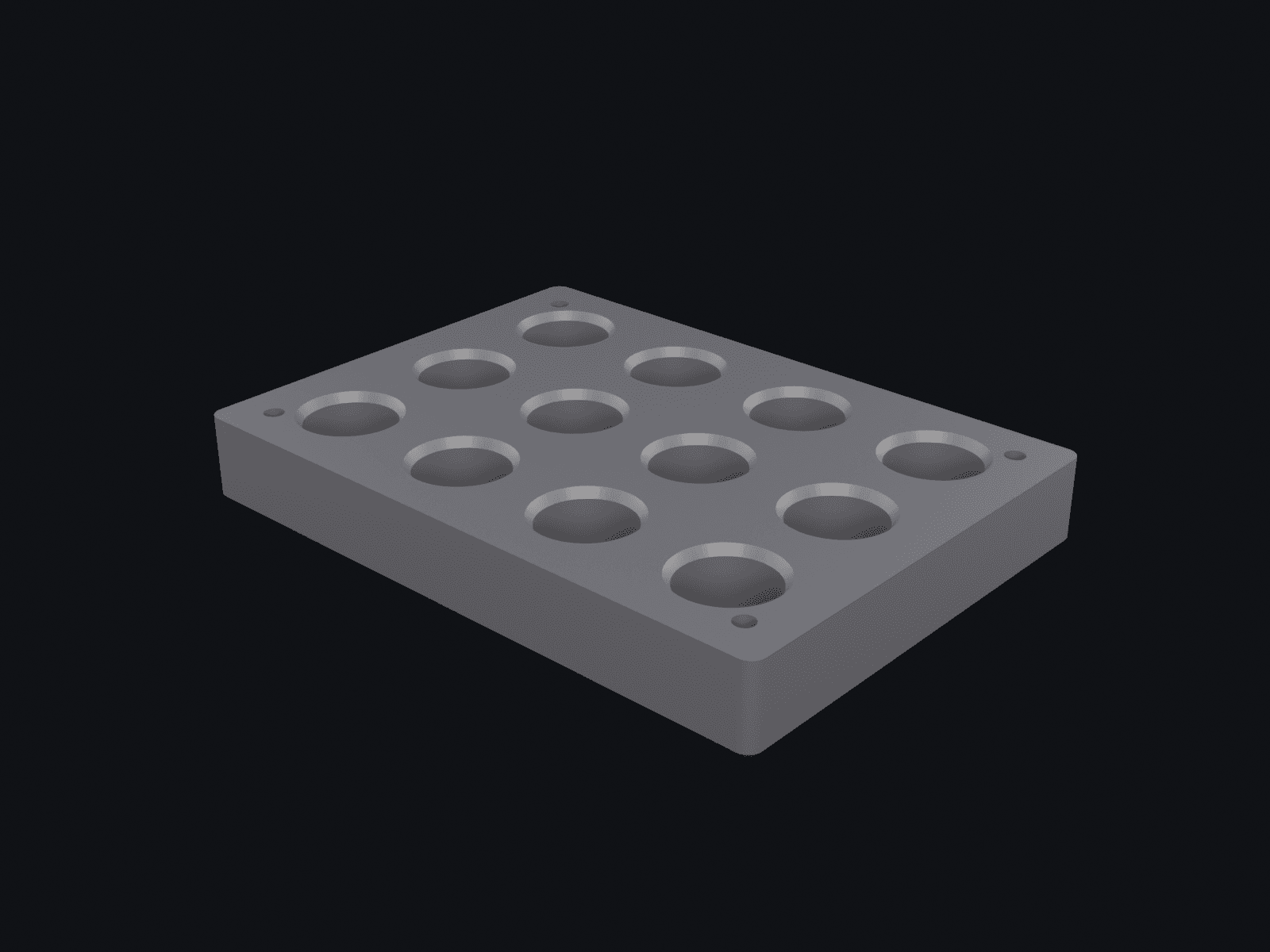
| Layout | 12 pockets (4×3); configurable grid, pitch, part Ø, fit |
| Validation | two load cases agree on mass to 0.00%; sag inside Roark plate bounds |
| Material | CF-Nylon; optional TPU no-mar pocket liner |
| Mount | 4 corner M5 bolts into the cell fixture |
| Analysis | CalculiX C3D10 — lateral g + gravity, equilibrium-verified |
Application and configuration notes
Parts are modelled as snugly-located lumped masses — a part with running clearance can also rattle within its fit, so we quote the structural locating shift and spec the pocket fit (a configurator input). Locating scales with part mass, CG height, and pocket count; the configurator re-solves per layout. CF-Nylon for stability; a TPU liner is offered for delicate parts (trades a little stiffness). The FEA is the design; an on-cell pick-success map is the deliverable.
Configure to your part
Enter the envelope of the part you need to inspect. We auto-size the 3-2-1 fixture, then run the real FEA to confirm the datum holds before you pay.
Estimate only — every fixture is FEA-validated for datum stability and quoted before work begins.
In use
The part
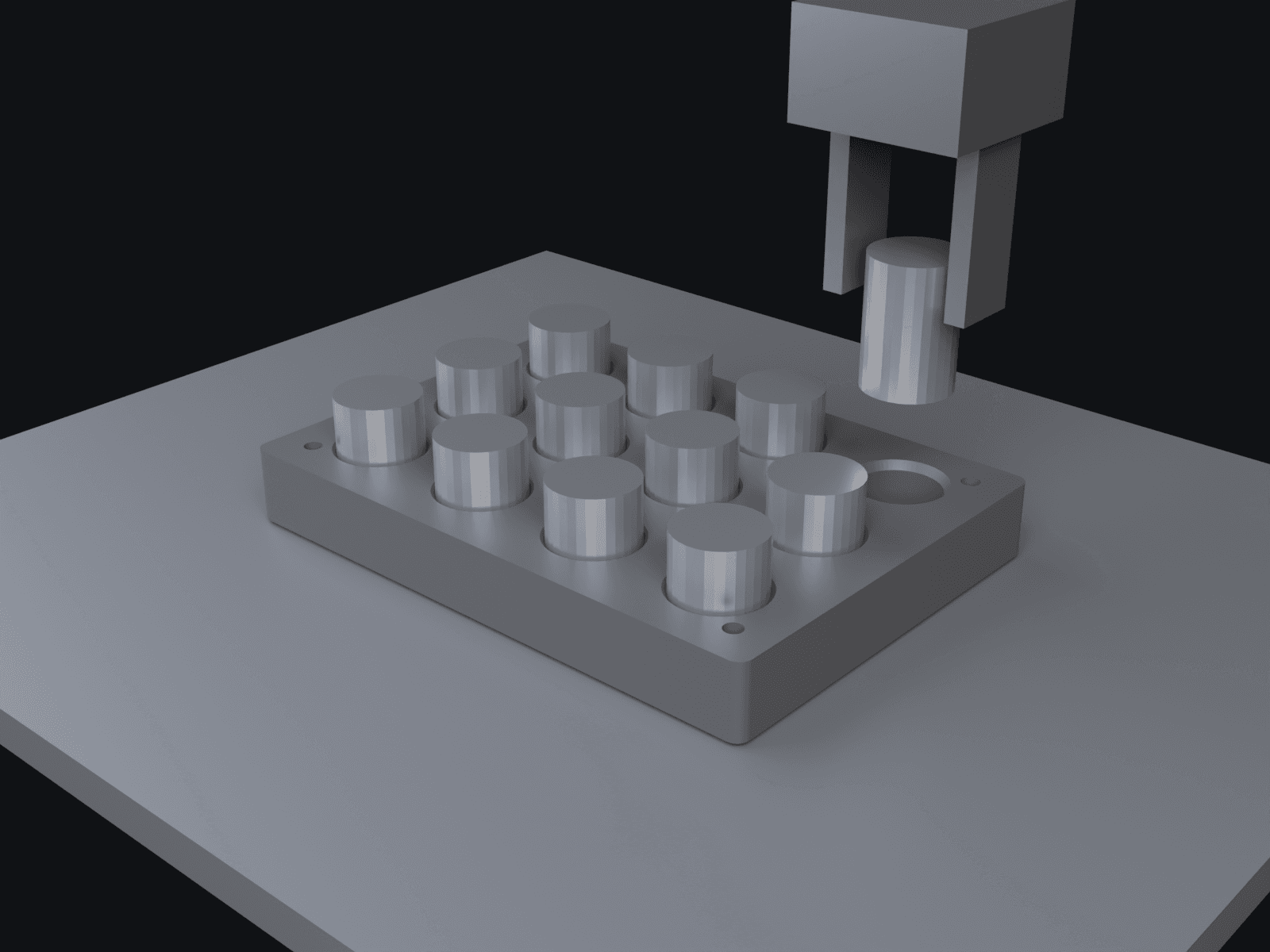
A multi-cavity nest that locates an array of parts to repeatable positions so a robot picks or places blind off a taught grid. It's the workhorse of automated kitting, assembly feed, and machine tending — and the one place a printed tray earns its keep is the complex layout, where a custom pocket array conforms to oddly-shaped parts that no off-the-shelf tray fits.
The thing that separates an engineered nest from a foam insert is that the parts stay put — and that a blind robot can actually drop them in. Each pocket has a 2.5 mm × 35° lead-in funnel so a misaligned placed part self-guides into the bore instead of jamming, and a deep locating bore (0.53 engagement) so a tall part can't rock. We don't assume the parts stay located — we compute it, honestly: loaded and shoved at 5g, the worst pocket holds its part's *as-picked top* to 42.8 µm — that's the wall deflection (0.8 µm) plus the clearance rocking the locating fit allows (42 µm), not just the wall number — 2.3× inside a ±100 µm robot pick budget. Under the loaded tray's own weight the parts present within 0.3 µm of a common pick height.
CF-Nylon for the one property that matters — dimensional stability — with an optional soft TPU pocket liner for no-mar handling of delicate parts. The pocket layout, pitch, part diameter, and locating fit are all parametric, so the nest configures to your part set and re-solves the locating stability for that exact layout.