Engineering Examples · Automation tooling & fixturing
Parts that stay located when the cell shoves them
A pick-and-place nest is only worth printing if the parts don't drift. We proved a 12-pocket nest holds every part to under 3 µm at 5g — 37× inside the robot's pick budget.
The result at a glance
Problem → built result
What we solved
Automated cells pick parts off nests blind — the robot is taught a grid of positions once, then trusts it. That trust breaks the moment the parts move. When the cell indexes the tray or a fast arm jostles it, every part feels a handling g-load, and if a pocket lets its part lean or shift out of the pick window, the robot grabs air and the line stalls.
What we built
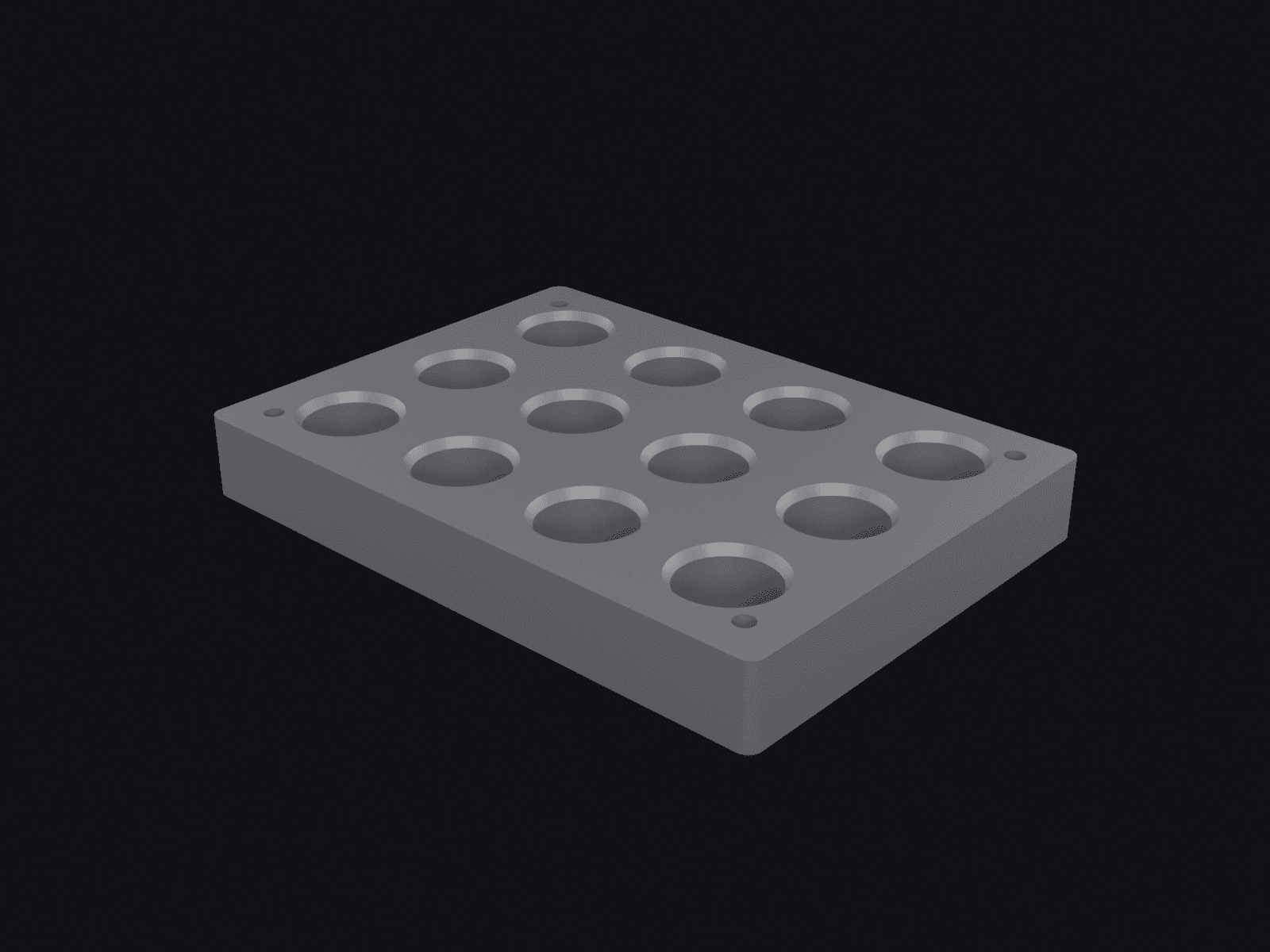
Make the pocket layout, pitch, and locating fit parameters, and load the whole nest in finite elements with the parts as masses sitting in their pockets — then push it. Two cases: a lateral handling g-load to see how far the parts shift in plane, and gravity to see how flat the part-top plane stays for a consistent pick height.
How we proved it
The engineering behind the result.
Locating shift, in microns
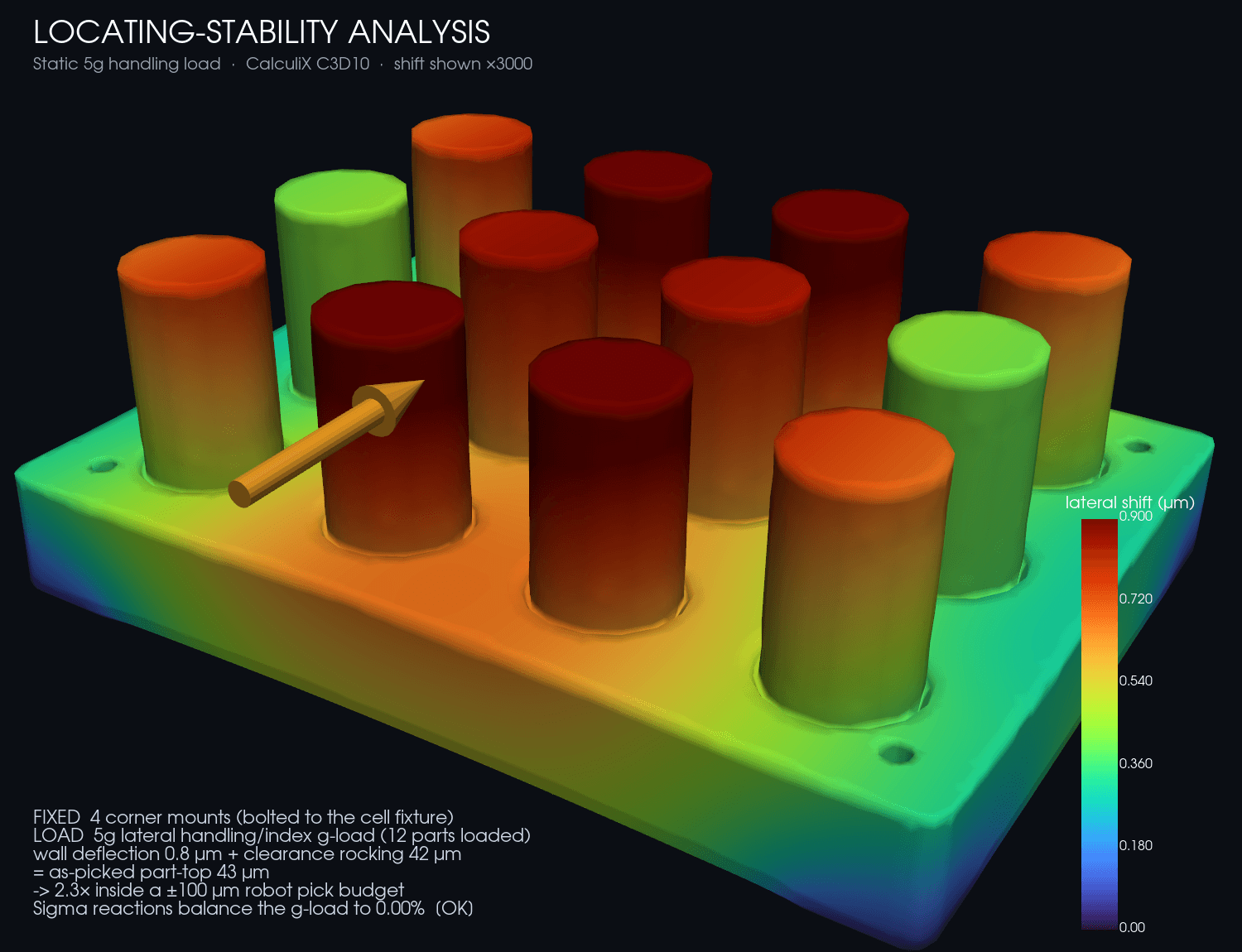
Loaded with twelve parts (2.5 kg) and shoved at 5g, the worst pocket holds its part's pick position to 2.7 µm — 37× inside a ±100 µm robot pick budget. The parts visibly lean in the analysis, but only by microns, so the robot keeps hitting its taught grid.
Consistent pick height too
Under the loaded tray's own weight the part tops present within 1.9 µm of a common plane — so the robot's Z approach is as repeatable as its XY. CF-Nylon is the material choice for exactly this: dimensional stability, not strength, is what locating demands.
Two load cases that check each other
The lateral and gravity solves independently imply the same 2.50 kg total mass — agreement to 0.00%, the model validating its own mass. And the gravity sag lands between a clamped-plate and a simply-supported-plate hand-calc, an independent bracket on the stiffness.…
Delivered result
Evidence a buyer can use.
A custom nest that ships sized to the customer's part set, with the analysis proving the parts stay located when the cell handles them — not a tray that's 'probably fine.' Honest gates travel with it: parts are modelled as snugly-located masses (a running-clearance part also rattles within its fit, which we spec), locating scales with part mass and count so…
Application notes
Parts are modelled as snugly-located lumped masses bonded to the pocket wall and seat — a part with running clearance can also rattle within that clearance, which the locating-fit tolerance (a configurator input) sets; we quote the structural locating shift and spec the fit.…
Quote
Configure the Pick-and-Place Nest / Tray.
Photos, a drawing, or dimensions. We’ll quote the job if we can take it.