Shop · Production Tooling, Jigs & Fixtures
CMM / Inspection Fixture
Holds your datum to under a micron — computed, not assumed.
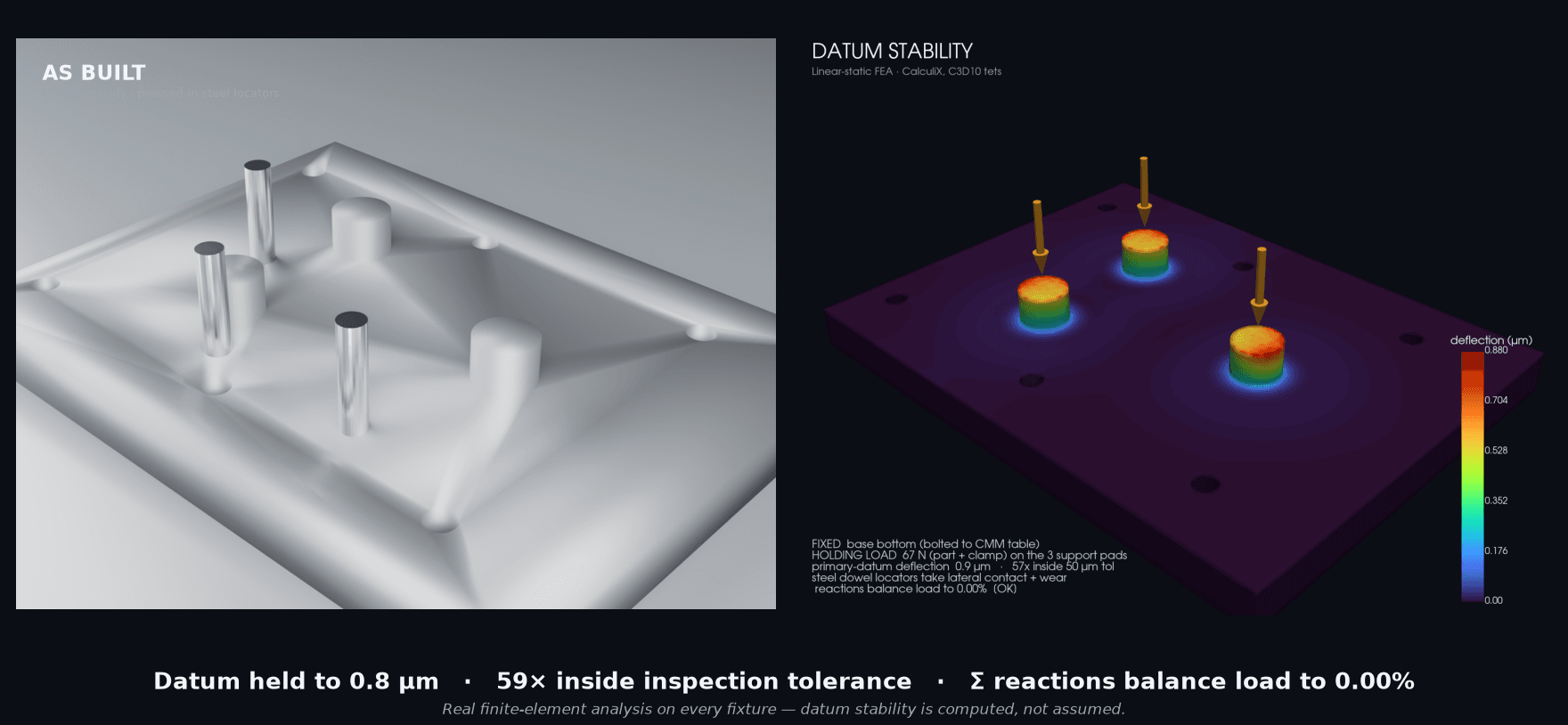
Σ reactions balance the holding load to 0.00%, and the primary datum moves 0.9 µm — 55× inside a typical inspection tolerance. The fixture does not corrupt the measurement under load, and the analysis proves it.
How we engineered this: a printed fixture trustworthy to a micron →
Specifications
| Primary-datum stability | 0.9 µm under a 67 N holding load |
|---|---|
| Datum margin | 55× inside a 50 µm inspection tolerance |
| Locating scheme | 3-2-1 (3 pads + 2+1 steel dowels) + toe/strap clamp |
| Material | CF-Nylon body, hardened-steel locators |
| Base | 160 × 120 × 22 mm, bolts to a real 25 mm M6 fixture-plate grid |
| Analysis | CalculiX C3D10 FEA, equilibrium-verified |
Application and configuration notes
Stiffness margin is for the 50 µm inspection class. The honest limit is thermal: CF-Nylon's CTE moves the 160 mm base ~5–8 µm per 1 °C, so this is sound at the 50 µm class with a thermal-soak/conditioning procedure — for sub-10 µm metrology-grade datums we spec steel rest buttons or a granite/steel hybrid, not a polymer fixture. Configured per part.
Configure to your part
Enter the envelope of the part you need to inspect. We auto-size the 3-2-1 fixture, then run the real FEA to confirm the datum holds before you pay.
Estimate only — every fixture is FEA-validated for datum stability and quoted before work begins.
The part
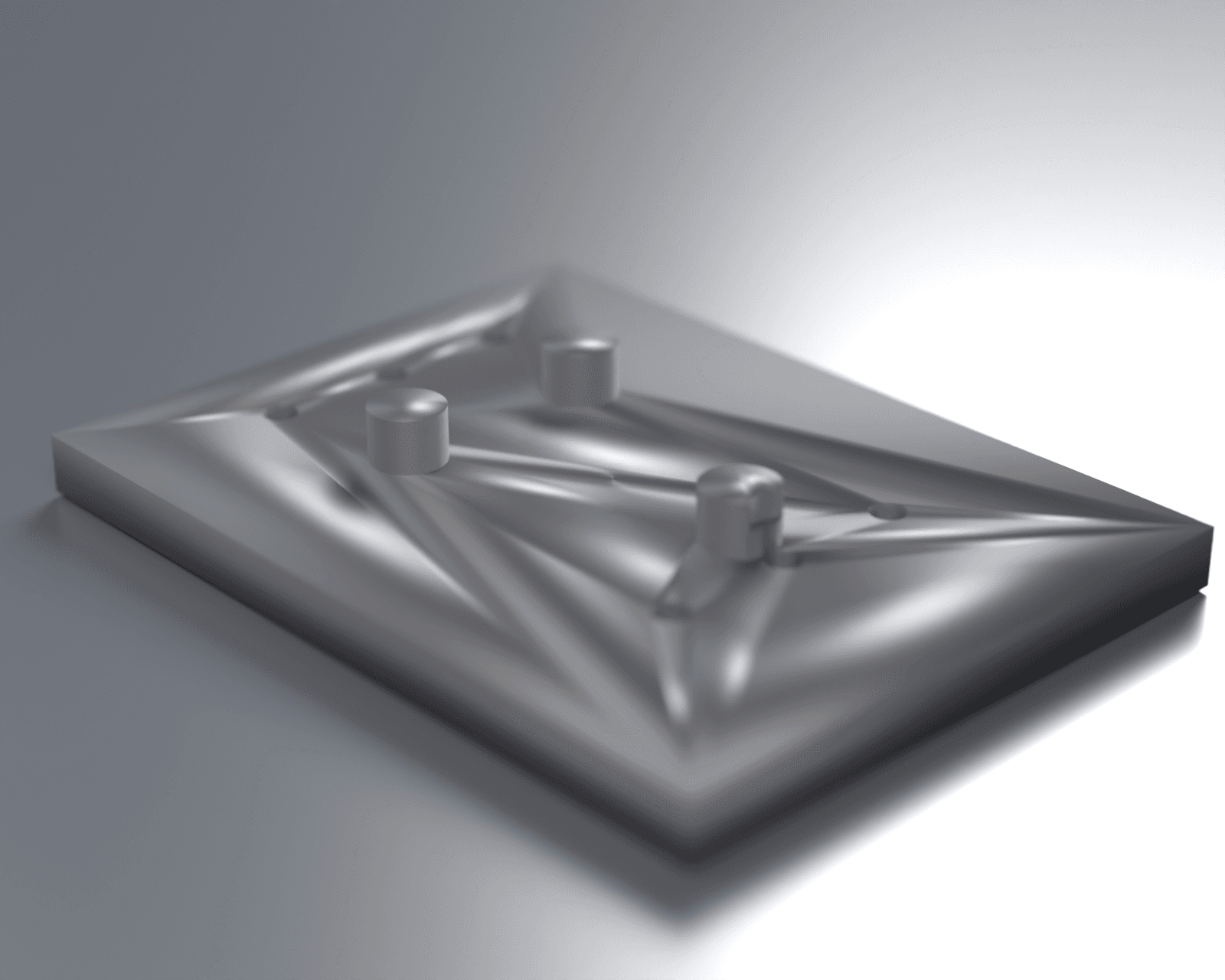
A 3-2-1 locating fixture that holds a part at a repeatable datum so a CMM probe — or an operator — measures features the same way every time. Three printed support pads set the primary datum; pressed-in hardened-steel dowel pins handle the lateral location and the wear.
Printed inspection fixtures are the application where additive genuinely wins: a conformal fixture that costs $2,000–$10,000 and weeks to machine prints overnight for a fraction of the price. The catch is dimensional stability — so we don't assume it, we compute it. Every fixture ships with the FEA showing the datum holds steady under the real holding load.
The pads carry the datum load in compression, where printed CF-Nylon is strong; the steel dowels take the contact and wear, where plastic isn't. That split is what makes a printed fixture trustworthy for metrology.