Engineering Examples · Robotics & UAS hardware
Sizing drone landing gear to the landing, not the datasheet
A printed cantilever leg that absorbs a hard landing — with the factor of safety computed by the energy method, not asserted.
The result at a glance
Problem → built result
What we solved
Drone landing gear is the part everyone copies off a free STL and nobody analyzes. That's fine until a commercial aircraft — a survey or inspection rig carrying a gimbal worth more than the drone — comes down hard. A leg that cracks on a 1 m/s touchdown costs a re-fly, a possible gimbal strike, and a grounded job.…
What we built
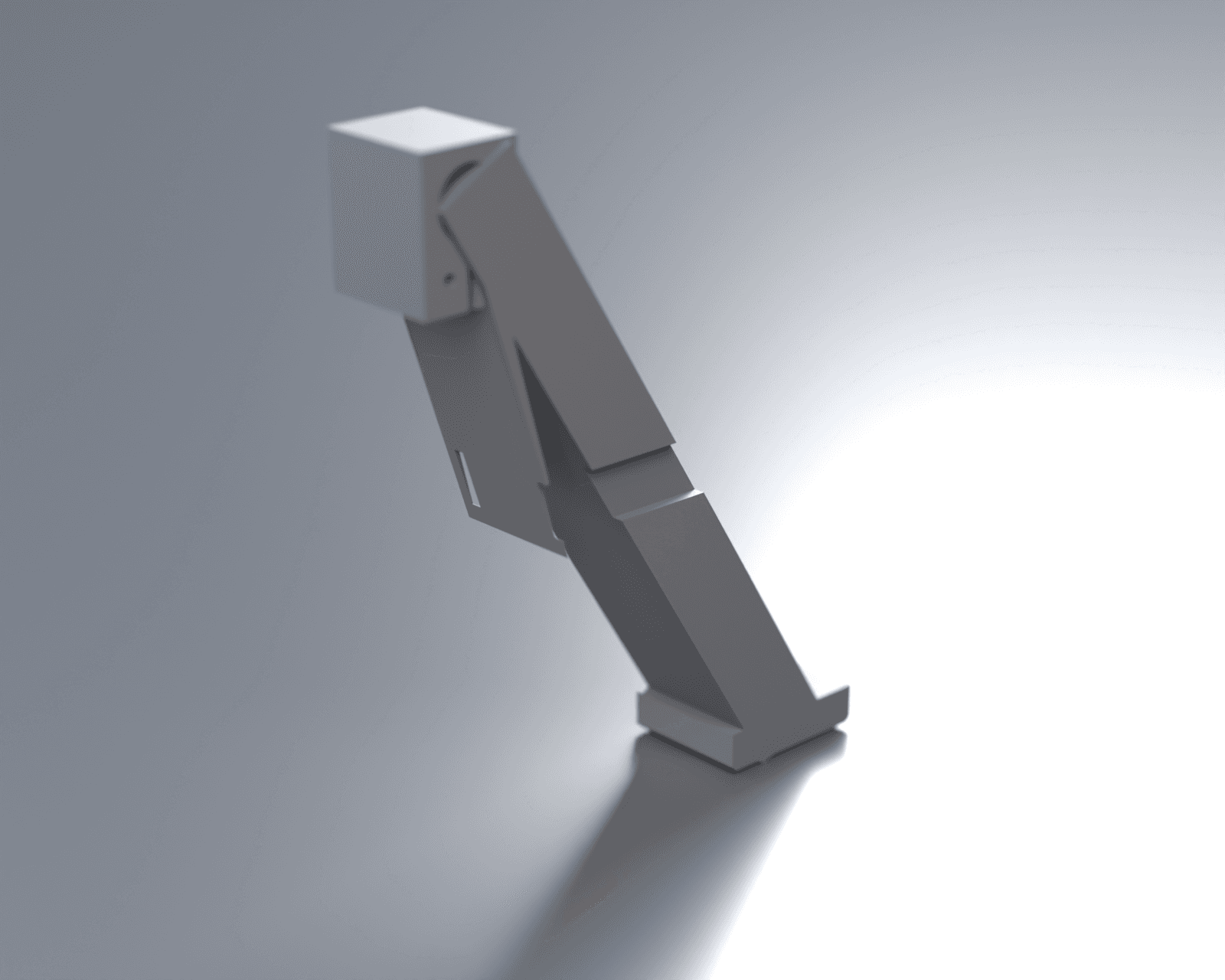
Treat the leg as what it physically is: a cantilever spring. Model it parametrically — a mount pad, a tapered blade strut, a skid foot — solve it once under a reference load, and read its stiffness and its stress-per-newton from that one finite-element analysis.
How we proved it
The engineering behind the result.
Material matched to the duty, not the spec sheet
Landing gear is an impact-and-fatigue part, and that pair narrows the field hard. Nylon-PA12 is the one common FDM polymer that takes both: TPU is too soft for a structural leg, CF-nylon is explicitly the wrong call for impact toughness, and PETG and PLA fail on fatigue.…
The factor of safety is an output
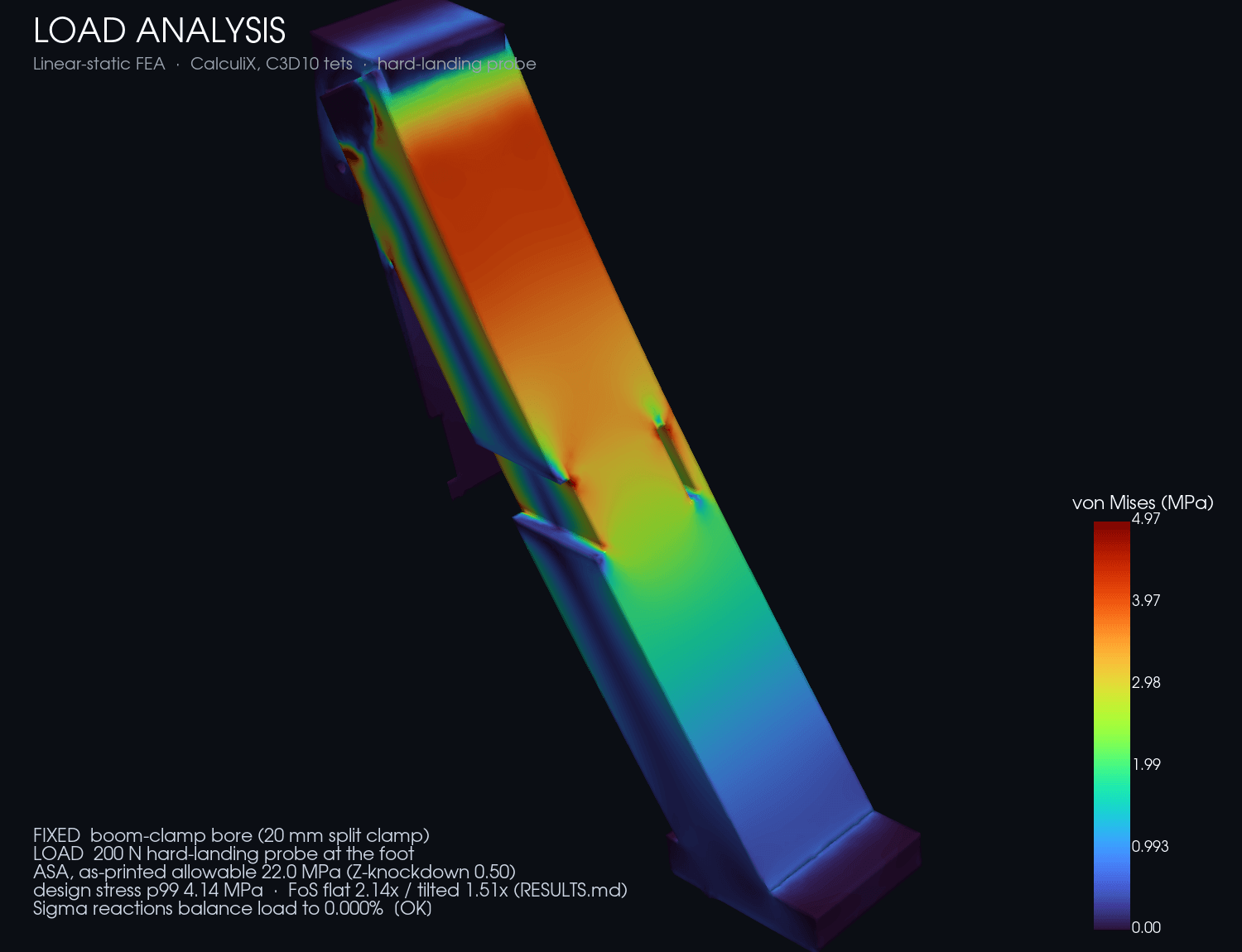
At the rated 1.0 m/s hard landing each leg holds 2.15× inside the as-printed allowable. A tilted touchdown that drops the whole descent energy onto just two legs still holds 1.52× — no yield. Standing at rest the margin is 64×.…
Proof the model is real
The reactions balance the applied landing load to 0.00% — a wrong finite-element mesh can't satisfy equilibrium, so that's the mesh validating itself. An independent hand-calc of the leg's stiffness as an inclined cantilever agrees with the FEA to 12%.…
Delivered result
Evidence a buyer can use.
A landing-gear leg that ships as a configurable product sized to the customer's aircraft, with the FEA that proves it survives the landing — not a traced STL with a hopeful weight on it. The honest gates travel with it: the rating is a single hard landing (repeated hard landings are a fatigue duty, which is why we chose nylon and offer a cyclic test), and th…
Application notes
The factor of safety is for a single hard landing. Repeated hard landings are a fatigue duty — Nylon-PA resists interlayer fatigue better than PETG or PLA, but we offer a cyclic-landing test rather than claim a life. The energy method assumes elastic absorption; a TPU skid foot (offered) softens the peak further.…
Quote
Configure the Commercial Drone Landing Gear.
Photos, a drawing, or dimensions. We’ll quote the job if we can take it.